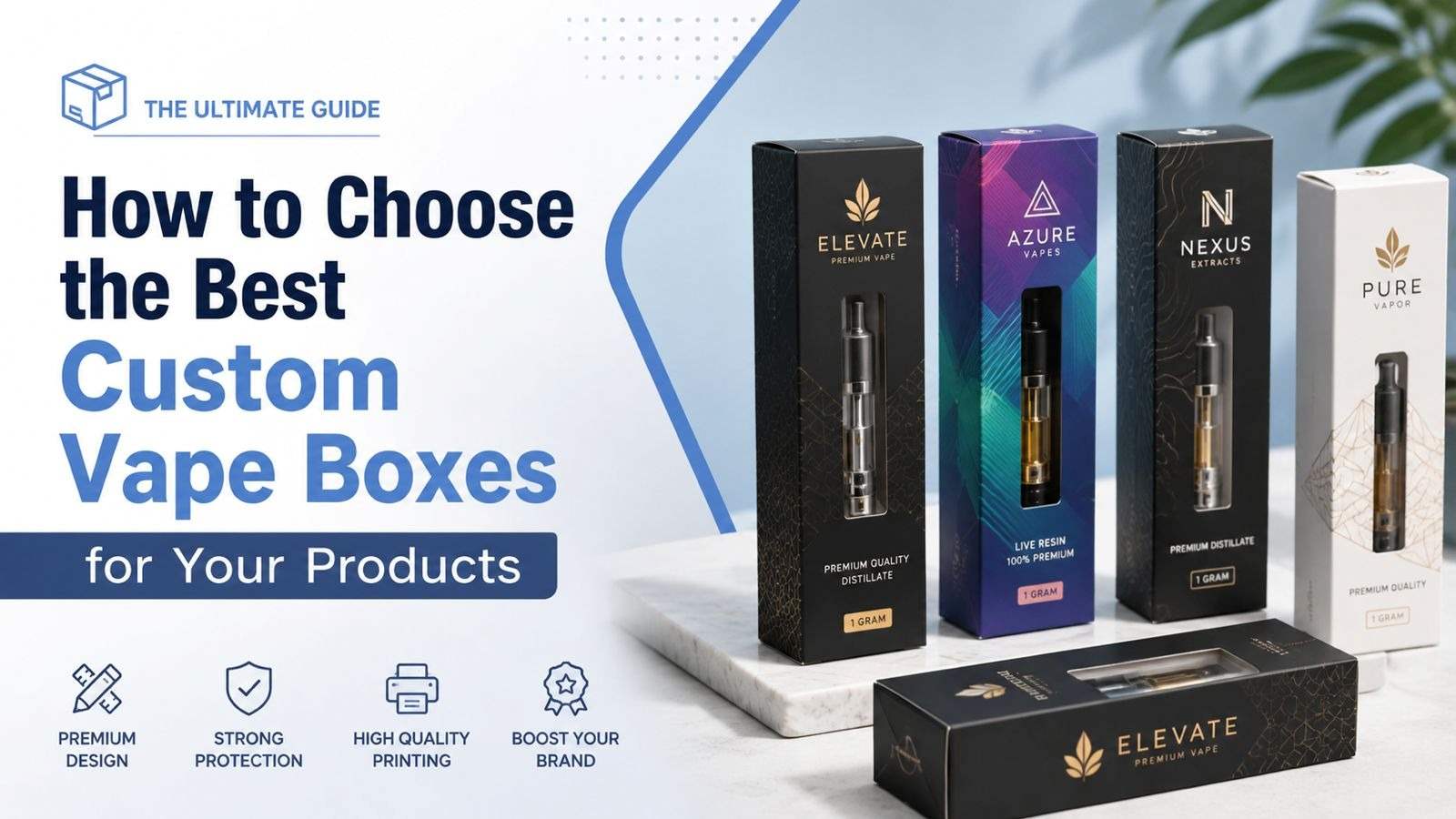
Choosing the right packaging can make a major difference in how customers see, handle, and store your vape products. The right custom vape boxes should protect the product, fit its dimensions, support your branding, and work well for your sales channel. A poorly fitted box can allow the product to move around, while weak packaging may increase the risk of damage during storage or shipping.
Before ordering custom vape packaging, consider your product type, box style, material, inserts, printing requirements, and applicable packaging requirements. This guide explains how to evaluate each factor and choose packaging that fits your product and business needs.
The following considerations provide a useful framework for developing or reviewing a packaging specification.
Start With Product Fit and Sales Channel
Good packaging starts with the actual vape devices, pods, cartridges, or accessories, not with a generic box size. Measure the product at its widest and tallest points, then allow only the clearance needed for loading, inserts, closures, and manufacturing tolerance. Too much space can make the pack feel cheap and can increase movement in transit; too little space can create bulging panels or difficult assembly. The sales channel matters as well.
A box designed for a retail shelf may prioritize face width and hanging or stacking behavior, while an e-commerce pack must tolerate additional handling. For custom vape boxes, dimensional discipline is one of the simplest ways to improve both presentation and cost efficiency.
Material selection should match the weight, fragility, print expectation, and price position of the product. Common options include
- Folding Carton Paperboard
- Rigid board
- Kraft
- Corrugated board
A lighter folding carton can be ideal when the primary pack already provides strength, while a heavier or rigid construction may be justified for gift sets or fragile products.
Board caliper should be chosen after prototyping because the same nominal thickness can behave differently depending on fiber composition, coating, grain direction, and box geometry.
For custom vape boxes, avoid choosing a premium material only for appearance; the best specification is the one that produces clean creases, reliable closure, efficient packing, and enough protection without unnecessary material.
Select a Structure That Supports the Product
Structure determines how the package opens, closes, stacks, and survives handling. Suitable formats can include
- Straight-tuck end boxes
- Reverse-tuck end boxes
- Tray and sleeve boxes
- Rigid setup boxes
- Vape display boxes
- Mailer-style kits.
- Child-resistant boxes
The choice should reflect how the product is filled, whether staff assembles boxes by hand or machine, how much shelf space is available, and whether the customer is expected to keep the pack after opening. Internal components are equally important. Inserts, platforms, partitions, or sleeves can improve alignment and reduce contact with outer walls.
When evaluating custom vape boxes, request a plain structural sample before approving artwork. A physical prototype reveals issues that a flat die line cannot show, including weak locking tabs, awkward opening force, excess movement, or a box that looks oversized beside the product.
Information architecture deserves the same attention as graphics. Depending on the product and market, panels may need space for product identification, variant details, batch or traceability information, barcodes, warnings, and other legally required statements.
Build the dieline around these requirements early instead of trying to squeeze them into leftover areas at final approval. Use a readable type size, clear contrast, and logical grouping so customers can find key details quickly. Leave adequate quiet space around barcodes and machine-readable codes, and confirm they scan after printing on the chosen finish.
For custom vape boxes, maintain an artwork checklist with fixed regulatory copy, variable batch information, and brand-controlled messaging separated into layers or zones. That reduces revision errors and makes future product updates easier to manage.
Keep Compliance Inside the Design Process
Compliance must be treated as a design input, not a final legal disclaimer. Vape and nicotine packaging is regulated in many markets; age-related warnings, labeling, branding restrictions, and other requirements should be reviewed for every destination market. Reserve space for mandatory statements before visual design is locked, and keep a controlled artwork version for every country or regulatory region. Do not assume that a package approved for one market can be reused unchanged in another. Claims, warning sizes, symbols, language, traceability, and even permitted branding can differ.
For vape boxes, the safest workflow is to have the responsible compliance or legal team approve the final artwork before plates, dies, or mass production are released. This is especially important when packaging is produced in one country but distributed in several others.
Final Thoughts
The final specification should be simple enough to reproduce consistently and detailed enough that suppliers do not have to guess. In practical terms, choosing the best custom vape boxes for your products means matching structure and materials to the product, keeping the visual hierarchy clear, reserving room for required information, and validating the finished pack before mass production.
Brands comparing custom vape boxes should request dielines and physical samples, test the complete packed product, and review print details at actual size. Sustainability and compliance should be supported by documented specifications, not vague claims. When these steps are followed, packaging can protect the item, support brand recognition, improve retail or e-commerce presentation, and create a more consistent customer experience without unnecessary cost or material.