The eco-friendly packaging is in higher demand than ever before. The safe properties of these packaging solutions attract the conscious consumer the most. Hence, Paper bags become an excellent choice to satisfy the modern audience. It also builds a positive brand impression when your priorities are planet safety.
After paper bags, the use of plastic has been reduced. They have negative impacts on the environment. So, custom paper bags come as a replacement for plastic packaging. It provides a safe, greener solution to all businesses. But do you know where paper Bags Come From? Let’s explore its answer through this complete guide.
Where Do Kraft Paper Bags Come From? (Origins & Early History)
Paper is not something that is a modern time invention. It is very old. The paper invention occurred in China around 105 AD. This was like paper that has the same properties. At first, it is used for writing and journaling.
Over time, people started using paper to wrap food, herbs, and objects. But these are simple paper sheets. They don’t work for carrying multiple items at once. This problem led the world to modern paper bag solutions.
The first paper bag appeared in 1852. It looks like a postal envelope. The man who invented the paper bag machine is Francis Woolley. This machine makes it possible to produce paper in large quantities. He was the Co-founder of the Union Paper Bag Company. This company play a big role in paper production.
Evolution of Paper Bag Designs Over Time
Envelope-Style Paper Bags
The first envelope-style paper bags look simply like flat bags. The production of these bags was very easy. However, their filling and transportation are difficult. These bags were mainly used for small items and lightweight goods. The flat surface of these bags is a major drawback. It makes them unstable for bulk cargo.
Flat-Bottom Paper Bags (1871)
In the 19th century, the flat-bottomed paper bag came. It was invented by Margaret E. Knight. It was his major contribution to the packaging industry. This type of bag can stand upright. So, it becomes easier for people to carry luggage without any difficulty. It also supports massive paper bag production. Margaret faced patent challenges but ultimately prevailed. Now he is the biggest name in Paper bag invention.
SOS (Self-Opening Square) Paper Bags (1883)
Charles Stilwell introduced the SOS paper bag in 1883. These bags are more practical than the earlier bags. They have an easy opening and stand without any support. These qualities make SOS bags efficient for product packaging. This meets industry standards and is useful for groceries and retail services.
Handle on Paper Bag (1912)
The inventor of paper bags with handles was Walter Deubener in 1912. These handles do magical work for customers. It gives ease in carrying products safely from the shop to the home. So, customers like these bags and give good reviews. After that, modern machinery was developed that created paper bags with handles easily. Now you see the variety of handles like twisted handles, flat handles, ribbon handles, and rope handles.
Raw Materials Used in Paper Bag Manufacturing
The raw material of a paper bag is wood pulp. You can get this from pine, spruce, and eucalyptus trees. There are basically two types of paper. Both have different properties. Virgin paper is reliable for durability. Recyclable paper brings no harm to the earth. So eco-conscious brands prefer to meet consumer demand.
Kraft Paper Explained
Kraft paper is a good choice for making eco-friendly paper bags. It is durable and safe for the environment. Kraft paper comes in different GSM levels. This helps to determine thickness and load capacity. Brown Kraft paper is an ideal choice to cater to sustainability requirements. It leaves no bad impact on the environment.
Laminated and Specialty Papers
The next paper bag type of material is laminated paper. It gives higher protection to the paper against moisture and dust. They also resist moisture and are suitable for food packaging. Coated food paper bags keep food fresh and edible. This also makes the printed packaging surface shinier and durable. However, the uncoated paper is more recyclable.
How Are Paper Bags Made? (Step-by-Step Process)
The manufacturing of paper bags goes through various processes. Here is the complete guide for customer understanding.
Step 1 – Pulp Preparation
This process starts with cutting wood. In this step, the wood is cleaned of impurities. It also breaks into pieces. These smaller pieces are cooked to separate the fibers to form a pulp.
Step 2 – Fabrication of sheets
The pulp is pressed and dried in large paper rolls. The thickness and quality are carefully controlled at this stage.
Step 3 – Cutting and Printing
Paper rolls are cut into specific sizes. Then printing is used for branding. This helps to boost brand image and satisfy customers.
Step 4 – Folding and Gluing
The paper is folded in the shape of a bag. Glue is applied to form the seams and base.
Different technologies are used for flat-bottom and pinch-bottom bags.
Step 5 – Manage production and attachments
The handles are made separately and attached with strong glue. Options include folded paper, flat paper, ribbon, and rope handles.
Water and Energy Use in Industry
The water and energy are used to produce paper bags. But now factories are shifting recyclable water solutions and renewable energy resources.
Explore Various Types of Paper Bags
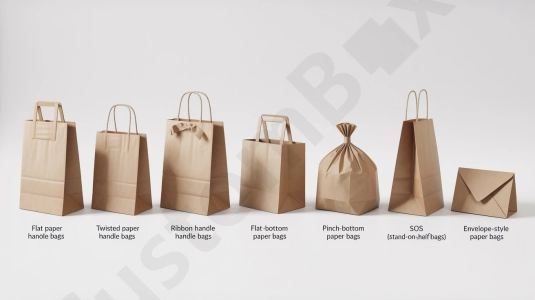
There is a variety of paper bags that give you ease in choosing the right one. All styles are efficient for carrying valuables.
- Flat Paper Handle Bags
- Twisted Paper Handle Bags
- Ribbon Handle Bags
- Flat-Bottom Paper Bags
- Pinch-Bottom Paper Bags
- SOS (Stand-On-Shelf) Bags
- Envelope-Style Paper Bags
Styles of Paper Bags and Their Functions
The versatile paper bags let you choose from a wide range of options. Each style has unique properties that make it efficient for certain roles.
Retail and Grocery Use
The most common place to use a paper bag is a grocery shop or a retail market. When they come with a handle, the customer journey becomes more comfortable.
Luxury and Boutique Packaging
The paper bag is also suitable for luxury product packaging. You can enhance their appeal with coating and elegant add-ons.
Food, Beverage, and Pharmaceutical Packaging
Paper bags are safe for food and medicine, cream packaging ideas when they are made from food products.
Bakery and Takeaway Packaging
The breathable property of a paper bag helps to keep good fresh.
Paper Kraft Bags Customization Options for Businesses
The customization of paper bags lets you choose the latest printing methods for greater results. The printing makes it easy to advertise your business among competitors. The offset printing is best for larger orders. Screen printing is ideal for highlighting your brand with bold designs. Digital printing goes well for short orders. With creative designs and brand elements, you can make a printed paper bag walking billboard. It will promote your business and make you reliable. You can also use bold, colorful themes to give an aesthetic appeal. It will help boost customer attraction.
Environmental Impact of Paper Bags
Paper bags are safe for environmental safety. They pose no threat to our planet. The biodegradable nature of paper bags makes them a preferable choice for businesses. The next advantage is that it decomposes easily and leaves no harmful elements. After decomposition, the benefit of paper bags is for nourishing the soil.
You can also reuse these paper bags for other products. The recyclable paper allows you to change a bag into a new product. In this way, the use of paper bags supports the circular economy. This process helps save energy, save trees, and reduce overall waste.
Paper Bag Vs Plastic Bag Comparison
The plastic bags are very harmful to our environment. They are not easily decomposed after use. Sometimes they remain in the ocean for a hundred years and destroy marine life. Meanwhile, the paper bags have less impact on the environment. It is a sustainable solution for the environment.
How Are Paper Bags Disposed Of?
Recycling of Paper Bags
The standard recycling system is best applied to paper bags.
Composting Paper Bags
The uncoated papers easily decompose at home or commercially.
Reuse of Paper Bags
You can use these bags for packing different products after their primary use.
Significance of Paper Bags in Retail and Daily Life
Paper bags have various benefits for the everyday life of individuals and businesses. Some of the uses of paper bags are given below.
The use of paper bags is common for transferring food or groceries. It has handles that make it more practical. Customers can also take grocery items safely from the shop to their home. The easy handling makes the customer experience better. Moreover, the retailers use paper bags as brand ambassadors. It gives you an edge on competitors.
Rise of Paper Bags in Branding and Marketing
The retailers give their branded paper bags free of cost to customers. They hand over these bags to those who shop for anything from their brand. This is a strong trick to become recognizable without paying for publicity. The printed paper bag with the brand name becomes a walking billboard for your business.
Bloomingdale’s “Big Brown Bag” is an example of how to become famous through packaging. The design of bags leaves a good impact on the customer's mind. It also influences brand perceptions.
Latest Trends in Paper Bag Packaging
With the passage of time, the paper bags have gone through different changes. The modern brands prefer sustainable materials for paper bags to show their support for sustainability. They also use water-based inks to keep packaging safe for the environment.
Although the paper bag should be lightweight, its durability still matters. Thus, brands customise the long-lasting paper bags. They enhance its functionality in various ways.
Growth and Future of the Paper Bag Industry
The paper bag industry is growing faster now than ever before. The use of recyclable packaging pushes businesses towards paper bag packaging. It helps brands to give customers reliable solutions that meet each country's standards. Plus, the sustainable paper packaging shows your professional behaviour to customers.
Innovations in Paper Bag Design and Production
In this modern world, the new innovations make paper bags more unique. The advancement in material science allows manufacturers to use higher-quality materials. It makes the paper bags extra safe for product packaging. The manufacturer also prefers safe dyes and adhesives to keep bags safe for our planet. Moreover, modern paper bags can carry heavier items without any difficulty.
Why Choose Paper Bags Over Plastic Bags?
The variety of reasons makes paper bags ideal than plastic bags.
Environmental advantages
The recyclable nature of paper bags makes them safe for our planet. It easily decomposes after use and brings no harmful impact on the environment. The recyclable bags allow you to reuse them later for other purposes.
Consumer Perception
What is more beneficial than getting positive reviews from customers? All this is possible with recyclable paper bags. It builds higher brand perception and shows your care for the environment.
Corporate social responsibility
The use of paper bags is reducing the use of plastic bags. This is the biggest achievement to keep the environment worthy of living. This gives a safer solution than the old ones.
Regulatory Trends
The paper bags meet the country's packaging regulations. They follow the specific laws of any country and meet the standard rules. The FSC certifications make it legally preferable.
Where Can You Buy High-Quality Paper Bags?
Choosing the Right Paper Bag Manufacturer is important to get quality paper bags. You can select those who have great repute and the latest packaging technologies. Also, consider the sustainability certification of the manufacturer to get better results. If you want to customize quality paper bags, i Custom Boxes USA is the best place. It follows the rules and regulations and gives sustainable paper bags to the brand.
Conclusion: The Journey of Paper Bags from Past to Future
The use of paper bags goes back a long way. Its environmentally friendly nature makes it a perfect choice for retail and food packaging. The customisation gives you ease in making your branded paper bags recognisable.
Frequently Asked Questions
Where does paper packaging come from?
The source of paper bags is wood pulp that we get from trees.
How are paper bags made?
It goes through various steps. First is the conversion of wood into paper. After that, it's cutting, folding, and designing.
Are paper bags made of cardboard?
They are usually made of kraft paper.
What raw materials are used for paper bags?
You can use wood pulp, kraft, or recyclable paper.
Are paper bags better than plastic bags?
Yes, of course, this is safer than plastic.
Are paper bags made of Kraft paper?
Yes, the most popular option is Kraft material.
How many years does it take for a paper bag to decompose?
It will easily decompose after use. The decomposition takes months, not years.
What are the raw materials for paper bags?
It is wood pulp.


